Help shoppers understand Sambalpuri sarees with accurate weave, fibre, motif and care details. A practical product-page brief for boutiques and buyers.
“Beautiful handmade saree” leaves the interesting part unsaid
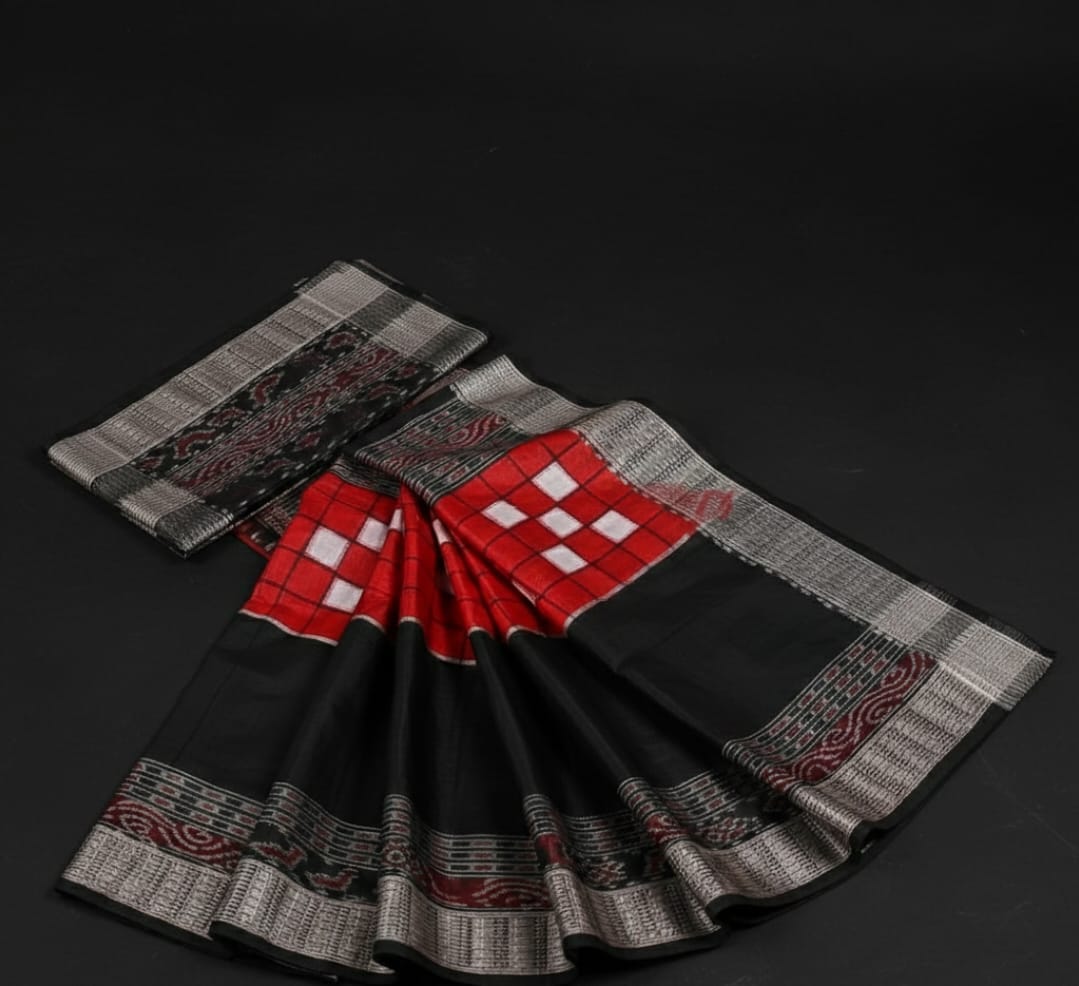
A shopper sees a rich red border, a patterned body and the word “handmade.” They may admire the photograph, but they still do not know what makes this particular saree worth choosing.
For a boutique sourcing Sambalpuri textiles, the opportunity is not to add more adjectives. It is to explain the product accurately enough that the shopper can picture owning it.
That starts before the stock arrives: with better information from the supplier.
Explain the process without inventing a story
Odisha’s Bandha, or ikat, tradition involves tying and dyeing selected yarn sections before weaving. That makes the process itself a useful part of a product description: the design is developed through yarn preparation and weaving, rather than simply printed onto finished cloth.
However, do not use one general description for every textile. Confirm whether the particular piece is yarn-dyed ikat, its weave construction and whether the handloom claim is supported. Not every saree from Odisha is the same construction, and an ikat-style image is not proof of how a fabric was made.
If you do not know the weaver’s name or production location, do not invent them to make the page feel personal. A precise description is more respectful than a fictional artisan biography.
Separate fibre, technique and place
“Sambalpuri” alone does not tell a shopper everything about the fibre, weight or care requirements. Ask for the actual fibre composition, the dimensions and the construction details for the stock you are buying.
Describe origin only to the level your sourcing information supports. Do not infer the production village from an exporter’s office address. Similarly, avoid presenting all Sambalpuri textiles as double ikat or all handloom sarees as naturally dyed.
Three separate facts—a fibre, a technique and a supported place of origin—are more useful than one sweeping authenticity claim.
Let the photographs do a specific job
A folded-stack photograph can show an assortment. It cannot explain the entire saree. Build a small, deliberate image set instead:
- A full-length view showing the body, border and pallu together.
- A close-up with the yarn structure and pattern visible.
- A separate pallu and border view for design comparison.
- A reverse-side detail to support the product discussion, not as a standalone authenticity test.
- A draped view showing scale and how the textile falls.
Photograph the actual stock and label colour variants clearly. Heavy saturation edits can create an expectation that the delivered product cannot meet. Screen differences should be acknowledged, but they are not a reason to avoid careful photography.
Turn the supplier brief into useful retail copy
Before writing the page, request fibre composition, dimensions, blouse-piece status, confirmed technique, care instructions, design references and available quantities by variant. Ask whether a repeat order can match the design exactly or may involve agreed variations.
Treat those details as product information, not obstacles to storytelling. They answer the questions a shopper might otherwise need to send by message.
Compare two approaches:
Weak: “Premium, authentic and luxurious Sambalpuri saree. Perfect for every occasion.”
Stronger structure: “A [confirmed fibre] Sambalpuri saree with a [verified motif or plain-language pattern description] body and contrasting [actual colour] border. The [confirmed technique] gives the pattern its character. Includes [confirmed blouse-piece detail]. See the full-length and close-up photographs for this exact variant.”
The brackets are a supplier-information template, not publishable claims. Fill them only with verified details for the listed piece. If the motif name is uncertain, describe what is visible rather than assigning an impressive-sounding traditional name.
Build a collection people can navigate
A boutique does not need every product page to tell the full history of Odisha weaving. Put the background in one useful collection guide, then let each listing describe its own piece.
Give shoppers consistent fields: fibre, dimensions, colour, pattern, blouse-piece status and care. Link the listings to the guide so a curious shopper can learn more without losing the buying details.
For social content, make one post answer one question. Explain how a pattern is made, show the pallu at full scale or demonstrate the difference between two actual colourways. Use real product footage for those demonstrations; an illustrative creative is a campaign cover, not evidence of the item being sold.
Bring the questions to your next sourcing enquiry
If you are planning a Sambalpuri assortment, ask for product-level information alongside the price and availability. View Jaonix’s Sambalpuri saree product page or send a sourcing enquiry with your required fibre, quantity, design preferences, destination and timeline. Confirm the details of the proposed stock before making retail claims.
“Handmade” can introduce the conversation. The details should carry it.
FAQs
Should every Sambalpuri saree be described as double ikat?
No. Confirm the construction of the specific piece instead of applying the same technique label to an entire assortment.
Can a photograph alone prove handloom authenticity?
Do not treat a photograph or one visual cue as conclusive proof. Combine product inspection with appropriate supplier information and supporting evidence.
What should a boutique ask before writing a product page?
Request confirmed fibre, dimensions, technique, design and colour details, blouse-piece status, care instructions and availability for the exact variant.
Research note for editor: Odisha Tourism — Handloom. This supports the short process explanation; the merchandising advice is original editorial guidance. No numerical improvement in sales or engagement is claimed.